
Alila Fort Bishangarh
Alila Fort Bishangarh
There is a moment, usually in the late afternoon, when the light falls across the granite face of Fort Bishangarh and the stone seems to glow from within. Not gold, not amber - something older than both. The walls here are finished in araish and surkhi, traditional lime plasters that Rajasthan's craftsmen once applied by hand to palace interiors, and at Alila Fort Bishangarh they still carry that quality of depth: surfaces that have absorbed two centuries of monsoons and dry seasons and come out more beautiful for it.
This is not a fort that was designed to receive flowers and drapes. It was built to hold ground, perched on a granite hillock above the Aravalli Range with the plains of Jaipur visible on clear mornings far below. And yet it has become one of the most sought-after wedding destinations in Jaipur precisely because of that severity - the way the rawness of the hills and the restraint of the architecture create a frame so powerful that anything placed within it carries weight. When Konark Weddings designs a wedding at Alila Fort Bishangarh, every element is in conversation with something that has stood for 235 years. That is not a constraint. That is the brief.
How Konark Weddings Reads This Fort
Most luxury wedding venues in Rajasthan communicate heritage through ornamentation - carved jharokhas, painted ceilings, gilded archways. Fort Bishangarh communicates through absence. The walls are clean. The proportions are severe. The material palette is mineral: grey granite, cream lime plaster, dark teak, terracotta. When we approach wedding decor at Alila Fort Bishangarh, we begin not by asking what we can add, but by understanding what the fort has already built.
That means every colour conversation starts with the stone. Ivory, champagne, dusty rose, and the warm ochres of Rajasthani soil read as extensions of the fort's own palette. Against this severity, bold statements become more powerful precisely because they are contained: a life-size peacock sculpture in orange marigold scallops, bending into a stone urn of pink lilies, placed on a checkerboard marble floor, carries the full visual charge of an object that knows exactly where it stands. The fort gives every installation that quality - the sense of having been placed, not simply added.
Lighting design is perhaps more critical at Fort Bishangarh than at any other venue in Jaipur. The fort's exterior face at night, lit from below, becomes a backdrop that no stage set could replicate. We treat that illuminated silhouette as a deliberate design element in every outdoor ceremony - the architecture as a living part of the composition, not a surface behind it.
The Spaces We Design
Aravalli Lawn
At 1,775 square metres with capacity for 300 guests, the Aravalli Lawn is the fort's most dramatic event space. Open to the sky with the Aravalli Range as a permanent backdrop, it is our canvas for large-format ceremonies and reception dinners that need room to breathe. The approach here is to treat the lawn as a theatre: a long central aisle drawing the eye toward a mandap or statement installation positioned at the fort wall. A tiered gold candle tower - stacked cylindrical discs holding rows of white pillar candles, topped with a carved silver finial - set against the fort's exterior at dusk, the wall glowing behind it, is exactly the kind of installation this space was made for.
Kachchawa Deck
This elevated terrace was once a royal escape route - a secret passage that opened to the sky above the fort. Today the Kachchawa Deck holds 15 guests, is exposed to the full panorama of the Aravalli horizon, and is unrepeatable in its atmosphere. We design it for mehndi mornings, sunrise pheras, or intimate first-look ceremonies where the couple wants the sky, the silence, and no audience. Decor here must be deliberately spare: low arrangements that do not interrupt the sightline, candlelight held against the Rajasthan breeze, fabrics that move rather than structure.
Nazaara - Indoor Hall
Nazaara is the fort's grand interior event space - 1,626 square metres with the height of a historic hall, seating up to 110 guests. Jaali screens line the walls; a checkerboard marble floor anchors the room. The controlled light environment makes this our canvas for installations that require darkness and precision: a life-size sculpted peacock in orange marigold garlands bending over a bloom-filled stone urn, a dusty rose botanical backdrop panel behind a seating arrangement, blush lounge furniture with fringe cushions in terracotta and coral. Nazaara rewards craftsmanship-forward decor - design that the guest discovers rather than immediately reads.
Haveli Terrace
The Haveli sits below the main fort, offering 550 square metres of terrace and garden access with capacity for 100 guests. It is our preferred space for mehndi and cocktail evenings - intimate enough for detail-forward design, open enough for a late-evening bar setup with a dramatic jewel-tone tablescape: blue delphinium, purple stock, white carnations and anemones, magenta chrysanthemums, all arranged low across a dark marble surface with pillar candles in glass and brass. The Haveli Terrace is where we design for proximity - decor that guests move through and around, rather than look at from a distance.
Decor Moments Built for This Fort
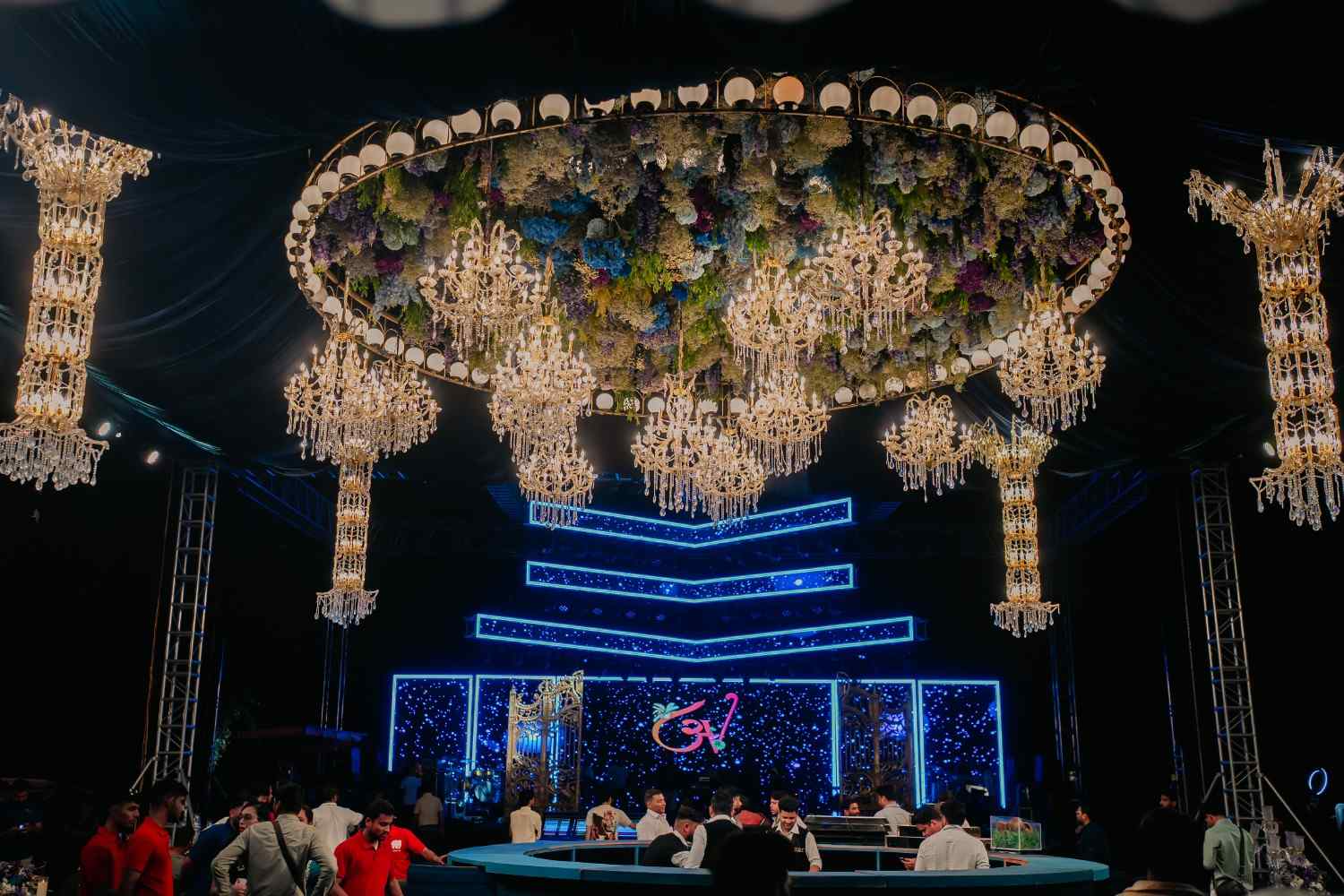
The suspended floral chandelier is the installation most closely associated with Konark Weddings at Alila Fort Bishangarh. A large oval gold truss ring holds clusters of blue and purple hydrangea, flanked by two towers of stacked crystal chandeliers rising from the floor on either side. Beneath it, a blue LED geometric stage carries the couple's monogram at its centre. The result is a decor environment that feels simultaneously intimate and vast - the chandelier pulls the ceiling down into the celebration while the stage and its light push the drama outward. It is a design that only works in a space with this particular ceiling height, darkness, and structural scope.
At Nazaara, our signature mehndi installation is the sculpted peacock - a life-size figure built from scalloped orange and red marigold garlands, the neck rendered in cobalt blue, bending as though drinking from the stone urn of lilies and gypsophila it stands beside. Set against a dusty rose botanical backdrop with white jaali screens on either side, and surrounded by blush lounge seating with terracotta linen, it anchors the entire room's visual identity. This is Rajasthani craftsmanship expressed as installation art.
For outdoor ceremonies on the Aravalli Lawn, the tiered gold candle tower is a recurring Konark signature at this venue - stacked cylindrical discs of decreasing diameter, each row holding white pillar candles, topped with a carved silver finial. Set at ground level with rose petals scattered at its base and silver candelabras with pastel florals on either side, the structure works because it speaks the same material language as the fort: layered, monumental, lit from within. With the fort's exterior wall rising above the treeline behind it, the candle tower and the 235-year-old stone seem to belong to the same sentence.
The jewel-tone sangeet tablescape is the counterpoint to all of this - an entirely different design vocabulary deployed at the Haveli Terrace after dark. Blue, purple, white, and magenta blooms arranged low across black marble, glass and brass candle vessels catching the light, a neon geometric stage glowing in the distance. It is deliberately contemporary, deliberately cosmopolitan, and entirely intentional: because Alila Fort Bishangarh is a venue confident enough in its own heritage to hold a modern celebration without any of that confidence slipping.
What Couples Planning a Wedding at Alila Fort Bishangarh Should Know
The decor conversation at Alila Fort Bishangarh should begin before almost any other. This is a heritage property with a specific material language, structural considerations around what can be suspended or anchored to the fort's surfaces, and property guidelines that govern large-scale installations. Starting the design brief early means your vision can be developed with these parameters in mind rather than adjusted around them closer to the date.
Most couples celebrating here are working with guests travelling from outside Rajasthan, often internationally. A three or four-day wedding programme across the fort's different spaces - indoor hall, lawn, terrace, elevated deck - requires that decor be conceived as a coherent visual journey across the full celebration. The colour story, the material palette, the floral language: all of it is established at the design stage, so that the mehndi in Nazaara, the ceremony on the Aravalli Lawn, the sangeet at the Haveli Terrace, and the reception under the chandelier all belong to the same world, even as each event has its own character.
Seasonally, winter (October to February) offers clear Aravalli skies and cool evenings ideal for outdoor ceremonies at full scale. Summer programming moves toward interior spaces and evening hours when the heat lifts. Whichever season you choose, engage your wedding decorator at Alila Fort Bishangarh five to six months in advance - the design process for a venue this specific takes time to do well, and the best installations at this fort are never improvised.
Begin the Design Conversation
If you are considering Alila Fort Bishangarh for your wedding, the design conversation should begin now - before the brief is written, before the mood board is assembled. The fort rewards that kind of early thinking. Konark Weddings has designed mehndi evenings, sangeets, ceremonies, and receptions within these walls, across these lawns, and against this sky. We know what Alila Fort Bishangarh asks of a decorator, and we know how to answer it.
Reach out to start the conversation about your wedding at Alila Fort Bishangarh.
Frequently Asked
Questions
-
We begin every wedding at Alila Fort Bishangarh with the architecture. Before a single floral choice is made or a colour palette is proposed, we study the spaces the couple has booked - the proportions, the existing materials, the light at different times of day, and the sightlines between events. From that reading, we build a design language specific to their celebration and specific to this fort. The result is decor that feels as though it could only have existed here: not imported from another aesthetic, not assembled from a catalogue, but grown out of a particular place on a particular set of evenings. That is what 18 years of designing weddings at Rajasthan's finest properties has taught us to do.
-
We recommend engaging your wedding decorator at Alila Fort Bishangarh five to six months before your wedding date, and ideally earlier for celebrations spanning three or more days or requiring large-scale bespoke installations. The design process for a heritage property at this level involves multiple site visits, vendor coordination, structural approvals, and sourcing timelines that cannot be compressed. Konark Weddings works with a select number of weddings each season to ensure that every design receives the depth of attention Alila Fort Bishangarh demands.
-
Alila Fort Bishangarh responds best to design that respects its mineral, austere aesthetic - which does not mean minimal, but does mean intentional. Ivory, champagne, dusty rose, warm ochres, and terracotta sit naturally against the fort's araish lime plaster and granite. Bold statements work powerfully here precisely because the fort's restraint amplifies them: a sculpted peacock in marigold orange, a suspended jewel-tone chandelier against a dark interior, a tiered gold candle tower silhouetted against the fort's exterior wall at dusk. Contemporary, Indo-fusion, and classically royal palettes all translate well at this property. What the fort does not reward is decor that competes with the architecture rather than conversing with it.
-
Alila Fort Bishangarh works with experienced external wedding design studios, subject to the property's vendor approval process and heritage property guidelines. Konark Weddings has an established working relationship with the Alila Fort Bishangarh team and is familiar with the structural considerations, installation constraints, and property protocols that govern decor at this venue. For couples building their vendor team independently, it is advisable to confirm vendor approvals with the property early in the planning process.
-
Konark Weddings is one of Jaipur's most experienced luxury wedding design studios, with over 18 years and 550 weddings across Rajasthan's finest properties, including Alila Fort Bishangarh. Our work at this venue spans mehndi installations in Nazaara, ceremony design on the Aravalli Lawn, sangeet tablescapes at the Haveli Terrace, and large-scale reception productions under suspended floral chandeliers. We design specifically for the visual language of each property, and Fort Bishangarh - with its mineral palette, severe proportions, and Aravalli backdrop - has an aesthetic logic that informs every design decision we make here.
-
Alila Fort Bishangarh is among the finest wedding venues in Jaipur for couples seeking a luxury destination celebration with genuine heritage character. Perched on a granite hillock in the Aravalli Range, 71 km from Jaipur, the fort offers a combination of restored 235-year-old architecture, spectacular natural surroundings, and world-class hospitality under the Alila by Hyatt banner. Its four event spaces - from the 300-guest Aravalli Lawn to the intimate 15-person Kachchawa Deck - allow multi-day wedding programmes to unfold across entirely different settings without leaving the property. For couples who want their wedding to feel specific to a place - rather than interchangeable with any other luxury venue - Fort Bishangarh is exceptional.